Table of Contents
Zanzibar’s real estate market is gaining serious momentum — and in 2026, the reasons are hard to ignore. The island now combines record tourism demand, a more supportive investment framework, and a still-limited supply of high-quality property generating wide interest to invest in Zanzibar. For investors, that creates a rare convergence: rental income potential today, alongside meaningful capital appreciation as the market matures.
This is not a speculative story. It is backed by data, policy, and the kind of structural supply-demand imbalance that serious investors look for.
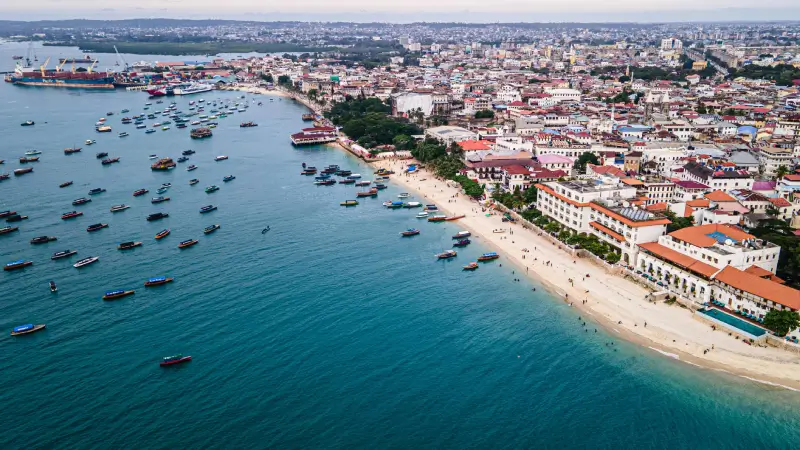
1. A Tourism Market That Is Now Large Enough to Move Property Prices
The biggest driver behind the boom to invest in Zanzibar property is tourism — and the numbers have crossed a threshold that matters.
Official data shows the island welcomed close to 1 million visitors in 2025, with tourism receipts reaching approximately USD 1.1 billion — a landmark figure for a small island economy. Zanzibar’s Office of the Chief Government Statistician publishes monthly tourism arrival releases, giving investors a reliable, trackable data source to monitor momentum in real time.[1][4][5]
Why does this matter for property? Because tourism is the engine that drives demand for villas, serviced apartments, boutique hotels, and short-term Zanzibar holiday rentals. When visitor numbers rise at pace, well-located property owners benefit first — through higher occupancy rates and stronger nightly yields.[3][1]
Independent hotel research reinforces the picture. C9 Hotelworks reported average hotel occupancy of 62 percent in 2023, with the typical visitor staying around eight nights — and the vast majority arriving for leisure.[6][3]

Monthly official statistics show occupancy strengthening through 2025, reaching 74.3% in September 2025 and around 89% in December 2025 [6][3]. That combination of sustained holiday demand and longer average stays makes Zanzibar particularly compelling for vacation rental and hospitality-linked real estate.
Shivo Tanzania have proven experience with rental occupancy on villas we manage, with an average annual occupancy rates at Shivo Paje Villas of 60-80% and 80-90% in peak season.
2. Why the Investment Case Is Stronger in 2026
The 2026 story goes beyond tourism growth. Zanzibar is now also backed by a more robust investment framework.
Tourism Growth Statistics:
- 2024 International Visitors: 736,755 (15.4% increase),
- 2025 International Visitors: 917,167 (24.49% increase from 2024)
- Peak Season Hotel Occupancy: 92.4% (December 2024, according to OCGS)
- Tourism Growth Rate: 12.7% sustained expansion
- Average Stay Duration: 8 days (supporting extended rental income)

The remarkable recovery story shows how after the COVID-19 impact in 2020 (260,644 visitors), Zanzibar experienced an extraordinary 110.4% recovery in 2022, followed by consistent double-digit growth. The destination has already exceeded its 2020 target of 500,000 visitors by nearly 50% in 2024, with 917,167 visitors for 2025 which shows a 24.49% increase from the previous year.
European Market Dominance:
71.6% of visitors in 2024 came from Europe, with Italy, Germany, France, and Poland as leading source markets (OCGS/The Citizen). European tourists typically seek high-end accommodations, creating sustained demand for luxury properties in prime locations.
In 2025 the percent of visitors from Europe was 73.9% and the same countries led the way for the EU.
Investment Impact: The Tanzania National Business Council (TNBC) forecasts tourism’s contribution to national GDP will reach 19.5% by 2025/26. Services constitute 47.8% of GDP, with tourism as the primary driver (Office of the Chief Government Statistician Zanzibar).
3. Superior Returns On Investment when Buying Property in Zanzibar
The Zanzibar property investment market offers compelling returns, with prime second-line beachfront properties and those in key prime locations like Paje leading performance metrics.
The Zanzibar Investment Promotion Authority confirms that approved investors operating within Free Economic Zone structures can access 100 percent foreign ownership, alongside incentives designed to attract strategic development projects. The Tanzania Revenue Authority further outlines tax reliefs, duty exemptions, and structured benefits for qualifying developments in Zanzibar.[2][7]

That policy environment matters because real estate investors need two things: demand and certainty. Zanzibar is increasingly delivering both. Strong visitor growth creates demand. The evolving legal and incentive structure improves the case for long-term capital deployment.[7][2]
The macro backdrop supports this further. Government reported through 2025 and 2026 points to continued expansion in tourism-linked receipts and broader economic growth, with Zanzibar targeting structural reforms to sustain the momentum.[8][9] Real estate here is not rising in isolation — it is being lifted by the wider economy.
4. Where the Best Returns Are Likely to Come From
For investors focused on returns, Zanzibar’s strongest opportunities sit within beach-led and tourism-linked assets — villas in high-demand coastal locations, serviced apartments, boutique hospitality products, and professionally managed rental homes positioned to capture holiday demand.[3]
The key advantage is a supply-demand imbalance that still works in investors’ favour. Prime coastal zones remain relatively undersupplied relative to the speed of tourism growth. That gap can support both rental income and capital appreciation — particularly for investors who enter early in well-planned developments or emerging coastal areas before prices converge upward.[9][1][3]
Length of stay is another structural positive. Zanzibar’s visitors are not transit guests; longer holiday stays give landlords more room to earn on a per-booking basis, support premium guest experiences, and improve occupancy economics across the season. For villas and serviced units, daily rates can be dynamically managed to optimise returns through high and low season.[3]
There is also a powerful dual-use appeal. Buyers are not only acquiring a holiday home — they are buying into a tourism ecosystem that can generate income when the property is not personally occupied. In a world where investors want assets that are both enjoyable and productive, that combination carries real weight.[2][3]
5. What a Realistic Investment Outlook Looks Like
It is worth being direct about what investors can reasonably expect.
Rental returns in tourism-driven markets can be genuinely attractive, but they depend on location, build quality, management quality, seasonality, and operating costs. The strongest investment cases combine all of these factors — not just a good address. This is something we at Shivo Tanzania have positioned ourselves around, to ensure all bases are covered for the best Zanzibar property investment opportunity.
The most accurate framing is this: To invest in Zanzibar offers the possibility of strong rental income from a fast-growing tourism market, alongside appreciation potential as the island develops. The properties that tend to perform best are those that combine location, build quality, and professional management — and that are underwritten on realistic occupancy assumptions rather than peak-season optimism.
Seasonality is worth modelling carefully. Tourism demand does fluctuate by month, and conservative occupancy assumptions will produce more reliable projections than headline figures alone.[1][2][3]

6. The Risks Worth Acknowledging
A credible assessment of Zanzibar includes the risks — and there are real ones to navigate.
Zanzibar is still an emerging market. Legal due diligence, land tenure clarity, construction quality, and professional property management all matter significantly. Not every beachfront location will perform equally well — access, infrastructure, and the reputation of the development can materially change outcomes.[7][2]
Investors should approach the market with the same rigour they would apply anywhere: verify ownership structures, understand the regulatory environment, and work with developers and advisors with a proven local track record and hands-on property management experience.
7. Why Discerning Investors Are Paying Attention
Zanzibar fits the profile that experienced real estate investors look for: visible demand, improving policy support, and an asset class that still has room to grow.
Tourism has now reached a scale that supports institutional-style hospitality demand. The incentive framework strengthens the investment thesis. And the island still has an early-stage feel compared with more mature resort markets — which is precisely where the upside lies and the growing interest to want to invest in Zanzibar.[2][4][1][3]
The most persuasive way to understand Zanzibar in 2026 is as a tourism-led property market with strategic long-term upside — not a speculative trade. That framing is both more accurate and more appropriate for the kind of discerning investor this market increasingly attracts.
Begin your journey in Zanzibar property investment, contact us today and view our unique landmark development projects with luxury properties such as Shivo Towers & Shivo Gardens

8. Sources
[1] Zanzibar Office of the Chief Government Statistician, Monthly Tourism Arrival Release 2025 — http://www.ocgs.go.tz/index.php/publication-report/29
[2] Zanzibar Investment Promotion Authority, Incentives — https://www.zipa.go.tz/incentives/
[3] C9 Hotelworks, Zanzibar Hotel Market Report — https://c9hotelworks.com/wp-content/uploads/2024/08/20240820_Zanzibar_Public-Report-1.pdf
[4] India Outbound: Zanzibar registers record USD 1.1 billion tourism receipts in 2025 — https://indiaoutbound.info/trade-news/zanzibar-registers-record-usd-1-1-billion-tourism-receipts-in-2025/
[5] ATTA: Zanzibar Z-Summit unveils US $1.1bn tourism receipts — https://atta.travel/resource/zanzibar-z-summit-unveils-us-1-1bn-tourism-receipts.html
[6] 4Hoteliers — https://www.4hoteliers.com/news/story/24805
[7] Tanzania Revenue Authority, Tax Incentives under the Zanzibar Investment Promotion and Protection Act 2004 — https://www.tra.go.tz/index.php/component/content/article/103-tax-incentives/170-what-are-tax-incentives-under-the-zanzibar-investment-promotion-and-protection-act-2004
[8] The Chanzo: Zanzibar’s service receipts hit USD 1.27 billion — https://thechanzo.com/2025/10/09/zanzibars-service-receipts-hit-usd-1-27-billion/
[9] The Biz Lens: Zanzibar tables Sh6.98trn 2025/26 budget targeting stronger growth and reforms — https://thebizlens.co.tz/2025/06/12/zanzibar-tables-sh6-98trn-2025-26-budget-targeting-stronger-growth-reforms/
This article is for informational purposes only and does not constitute financial, investment, or legal advice. Real estate investments involve risk, and past performance is not indicative of future results. Investors should conduct their own independent due diligence and seek professional advice before making any investment decisions. All figures and data referenced are sourced from third-party publications and have not been independently verified by the publisher.